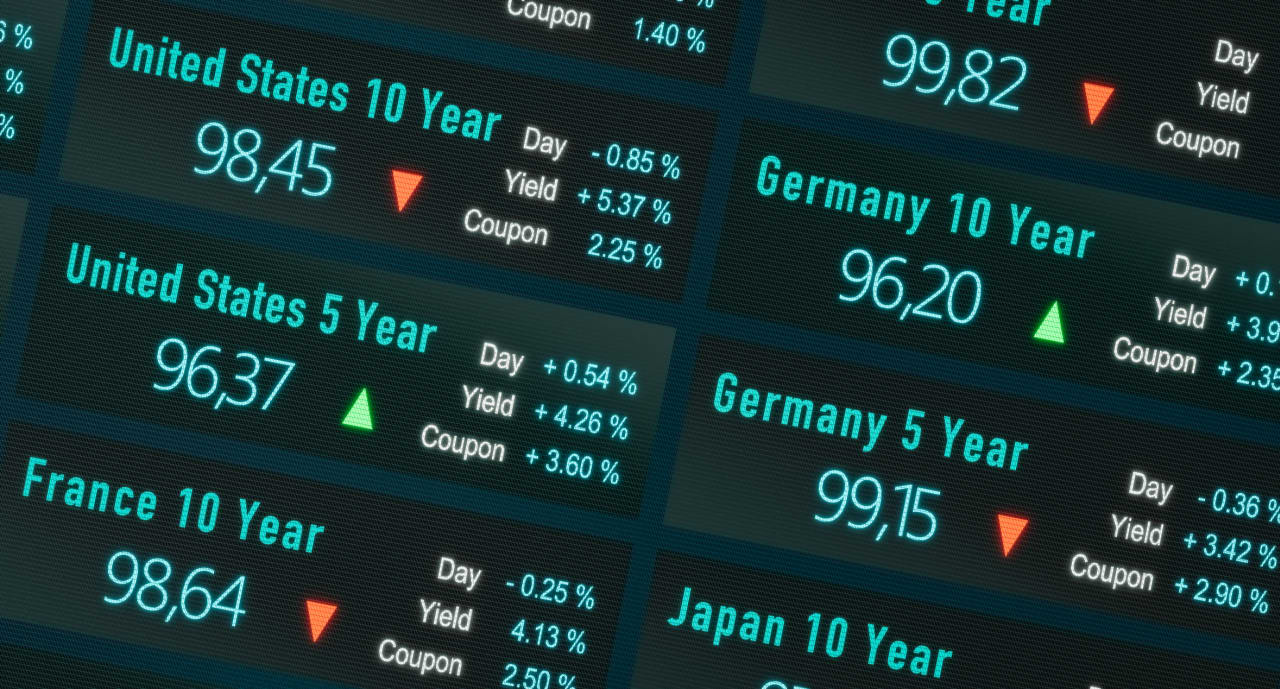
5.3% and Climbing: Highest Treasury Yields Since 2007 Set Up a Pivotal Week
The S&P 500 is celebrating the anniversary of its latest bull run, Seeking Alpha notes — but the tone underneath is dominated by the bond market. The 10-year yield above 5.3% is the year's defining story for equities,...
Quick Hits
- The 10-year Treasury yield hit 5.3% this week, its highest level since 2007, and it's reshaping everything around it — from CD and bond issuance to bitcoin's appeal, per The Motley Fool. Meanwhile, Fed officials want to hold off on a rate hike this month, but a hot inflation print this week could force their hand at the late-October meeting, MarketWatch reports.
- Big banks kick off earnings season Tuesday. JPMorgan Chase (JPM), Goldman Sachs (GS) and peers will give investors the first real read on how the economy is holding up in a 5%+ yield world, per CNBC. The setup isn't all gloom: Goldman just flipped bullish on equities for the rest of the year, citing resilient earnings and a cheaper market.
- The S&P 500 marked its latest bull market anniversary, Seeking Alpha notes — even as The Motley Fool points out the Nasdaq-100 has now posted three consecutive years of 20%+ gains (54% in 2023, 25% in 2024, 20% in 2025), a streak it says rests on far stronger earnings than 1999's version.
- Semis are bifurcating: Micron (MU) trades near $1,030, down 18% from its June 25 record of $1,255, while AMD (AMD) is up more than 180% year to date. Nvidia (NVDA) and Micron also caught "very bad news" from an unlikely source: Australia, a major AI data-center hub, per Fool.
- Lockheed Martin (LMT) raised its dividend 4.3% to $3.60 per share, Seeking Alpha reports.
Markets Overview
The S&P 500 is celebrating the anniversary of its latest bull run, Seeking Alpha notes — but the tone underneath is dominated by the bond market. The 10-year yield above 5.3% is the year's defining story for equities, driving up borrowing costs across the economy with inflation still above the Fed's 2% target, per Fool.
beneath the index level, dispersion is stark. Micron sits 18% below its record $1,255 close; AMD has more than tripled off its lows with a 180%+ YTD gain. Eli Lilly (LLY) has pulled back 8% but remains up 41% over the past 12 months and has more than doubled over three years.
Earnings Reports
Bank earnings take center stage Tuesday, with JPMorgan, Goldman and the other majors setting the tone for the entire reporting period, per CNBC. MarketWatch frames the stakes: this is the first broad look at how higher yields are actually affecting the economy — borrowers, deal flow, and credit quality.
The week ahead is just the warm-up:
- Microsoft (MSFT), Oct. 28 — Shares trade around $533, less than 2% below the record close of $542.07 set Oct. 28, 2025. Fool argues the key number is Azure growth staying above 40%.
- Sandisk (SNDK), Oct. 29 — A stress test for flash-memory pricing: sales fell 38% in the last downturn, though the company recently earned roughly 85 cents of gross profit per unit sold in fiscal Q4, per Fool.
- Bloom Energy (BE) — Reports in late October with the stock up a staggering 2,350%, and Fool is holding for one key number.
- OpenAI's revenue report has reignited the debate over whether AI stocks are worth buying at current levels, per Fool.
Fed & Economic Data
The Fed's late-October meeting is the pivot point. Officials would prefer to hold rates steady this month, but a troubling rise in prices revealed in this week's inflation data could trigger a hike, MarketWatch reports.
The backdrop is uncomfortable by any measure. The Motley Fool reports that Fed Chair Kevin Warsh and the FOMC have "fired a warning shot" at what it calls the second-priciest stock market in history, and separately traces what historical Fed warnings have meant for equities. The 5.3% 10-year yield means CD issuers and bond funds must raise their payouts to compete — bearish, Fool argues, for bitcoin.
The rate squeeze lands unevenly, MarketWatch notes in its retiree-focused piece: higher borrowing costs create winners and losers rather than the uniform pain of, say, higher gas prices. On that front, President Trump has floated a federal gas tax holiday, though Fool expects it would likely backfire.
Hot Sectors
Semiconductors remain the market's designated battleground. The bull case: Gartner projects AI infrastructure spending approaching $2 trillion in the coming years, underpinning Fool's three-year case for Taiwan Semiconductor (TSM). The bear case: Australia — just 28 million people but a major AI data-center hub thanks to its land mass — has delivered bad news to Nvidia and Micron, per Fool. Navitas (NVTS) is drawing dip-buying debate after a volatile 2026.
Healthcare is quietly working. AbbVie's (ABBV) dividend yield sits at its lowest since 2018 — and Fool still calls it a buy for income investors, a signal of price strength rather than payout trouble. Eli Lilly's 8% pullback is being framed as a historical buying-pattern question.
Energy rounds out the leaders: ConocoPhillips (COP) and Chevron (CVX) are among eight energy stocks earning A+ profitability grades from Seeking Alpha's screen.
Stock News
- Lockheed Martin (LMT): dividend up 4.3% to $3.60 (Seeking Alpha).
- Clorox (CLX): Investors need to own shares by Oct. 28 to qualify for the next dividend, yielding 6%, per Fool.
- Rocket Lab (RKLB): Cathie Wood's ARK keeps buying on the way down — disclosed purchases include 705,102 shares on Aug. 31–Sept. 1 and another 359,612-share wave since — with the stock at less than half its record, per Fool.
- Abbott (ABT): Trading under $100, with a conservative Fool model suggesting roughly $210 per share by 2036.
- Butterfield (NTB): A major acquisition is doubling the size of the 168-year-old Bermuda bank's business, per Fool.
Market Analysis
Three threads converge this week. First, the inflation data: it's the gatekeeper for whether the Fed holds or hikes in late October, and MarketWatch's framing suggests the bar for a hike is a "troubling" print. Second, bank earnings starting Tuesday will test whether Goldman's bullish call — grounded in earnings resilience and cheaper valuations — holds up against the yield backdrop. Third, watch the AI complex: Microsoft's Oct. 28 Azure number, Sandisk's memory-pricing check on Oct. 29, and the Australia data-center fallout for Nvidia and Micron will all stress the same theme from different angles.
For income investors, the calculus is shifting in real time: a 5.3% risk-free-ish 10-year yield is now the competition for every dividend stock and every bitcoin thesis on the board.
Sources