Stocks Slide as Iran Tensions Escalate, Tesla Deliveries Disappoint, and Gold Loses Its Safe-Haven Shine
Markets Overview
The sell-off deepened Thursday as geopolitical risk and macro anxiety gripped Wall Street. The S&P 500 is now down almost 9% from its January record high, with oil prices hovering near multiyear highs amid the ongoing conflict in the Middle East. Stock futures sank Wednesday night after President Trump said the U.S. is on track to complete Iran objectives "very shortly," offering no new signs of de-escalation.
Gold broke character, falling sharply alongside equities — abandoning its traditional safe-haven role in a move that rattled portfolio hedging assumptions. The metal's price drop reinforced a troubling pattern where gold has started tracking the broader market's mood rather than serving as a counterweight during crises.
The Vanguard Total Stock Market ETF (VTI) is down from its highs, but its 52-week range tells a more nuanced story. Geopolitical conflict in the Middle East has upended global energy markets and stoked fears about economic growth, leaving investors wondering whether elevated oil prices will tip the economy toward stagflation. Google searches for "stagflation 2026" have surged more than 650% over the past three months.
Earnings Reports
Tesla (TSLA) shares fell after a delivery report that came in well below Wall Street expectations, with analysts saying the company is "actively sacrificing" its EV business. Energy-storage deployments also disappointed, raising questions about both sides of Musk's growth narrative as the SpaceX IPO hype intensifies in the background.
Nike (NKE) lost 15% in March after a disappointing fiscal Q3 earnings report, though the stock was already slumping heading into the print. However, earnings actually beat expectations significantly, creating a mixed signal — the stock is now one to watch as investors parse whether the worst is priced in.
CoreWeave (CRWV) is generating both excitement and concern after its recent IPO. Revenue surged 168% last year to $5.1 billion with a $66.8 billion backlog, and the AI cloud computing company is guiding for revenue north of $12 billion. But the bull case comes with a caveat: $21 billion in debt and heavy customer concentration risk.
Interactive Brokers (IBKR) ticked higher after reporting robust March trading volumes, benefiting from elevated volatility as investors across American capital markets continued to trade actively through the turbulence.
Norwegian Cruise Line (NCLH) cratered 24% in March, lagging peers Carnival (CCL) and Royal Caribbean (RCL) due to lingering concerns about mismanagement. Royal Caribbean holds a clear profitability advantage over Carnival, though both posted record results over the past year on strong post-pandemic demand.
Fed & Economic Data
Stagflation fears are dominating the macro conversation. With oil prices spiking on Middle East tensions and consumer sentiment souring, the classic stagflation cocktail — stagnant growth plus persistent inflation — is back on traders' minds. Tariff uncertainty is compounding the problem, threatening to layer additional inflationary pressure on an already fragile consumer.
The case for a Q2 rebound is building, but far from certain. Historical evidence suggests the S&P 500 could recover in the second quarter, though the wall of uncertainties — from AI-driven growth questions to the war in Iran — makes any forecast unusually speculative. Investors are watching for signals on whether the Fed will have room to cut if growth falters while inflation stays elevated.
Hot Sectors
Semiconductors are in the spotlight ahead of TSMC's April 10 report, which could be a pivotal moment for the sector. Supply constraints and geopolitical risk — not just AI demand — are increasingly driving semiconductor stock performance, marking a shift in the investment thesis.
Nvidia (NVDA) stumbled in Q1 but remains the AI bellwether. CEO Jensen Huang's projection that Blackwell and Vera Rubin chips will generate $1 trillion in lifetime sales gave bulls ammunition, though the stock is still digesting a 500%+ three-year run. The Vera Rubin platform could create new AI "millionaire-maker" stocks by year-end, particularly among suppliers in the ecosystem.
Micron Technology (MU) has been "kicked to the curb," losing as much as a third of its value in recent weeks despite being positioned at the center of the memory supercycle. The sell-off may be overdone for long-term investors willing to look past near-term volatility.
Oil & energy names are catching a bid with Brent crude near decade highs. Chevron (CVX) is drawing renewed attention as a potential beneficiary, though the elevated prices that help producers could simultaneously choke the broader economy.
Stock News
The SpaceX IPO is generating massive hype, with the company reportedly targeting a public listing that would make it one of the most anticipated debuts in history. Investors should temper expectations — Musk's track record with public companies is a mixed bag for shareholders seeking steady returns.
Starbucks made two big turnaround moves Thursday — launching an employee bonus and tipping program while announcing a deal to hand off a significant slice of its China store business to an investment firm. Neither move helped the stock, but Deutsche Bank added it to a market-beating "fresh money" list alongside Delta (DAL) and CVS (CVS).
ServiceNow (NOW) has been cut nearly in half since last summer, caught in the crossfire of the software sell-off driven by AI disruption fears. The irony: ServiceNow must sell the same AI technology that could eventually replace its core workflow automation business — a existential tension the market is pricing aggressively.
Palantir (PLTR) is down 17% year-to-date, trading around $148 after soaring last year. The AI data analytics specialist is testing investor patience as the broader rotation out of high-multiple tech names accelerates.
American Express (AXP) shares have shed about 20% since the start of 2026, pulling back to around $300 on broader macro concerns — though the company's premium customer base and dividend track record make it a name long-term holders are watching for a potential entry point.
Market Analysis
The "Great Rotation" is real but nuanced. Money is shifting away from high-flying AI stocks, but megacap growth names like Alphabet (GOOGL) and Microsoft (MSFT) still offer compelling long-term value, particularly as AI infrastructure spending creates durable revenue streams. The key question is whether this is a healthy repricing or the start of something uglier.
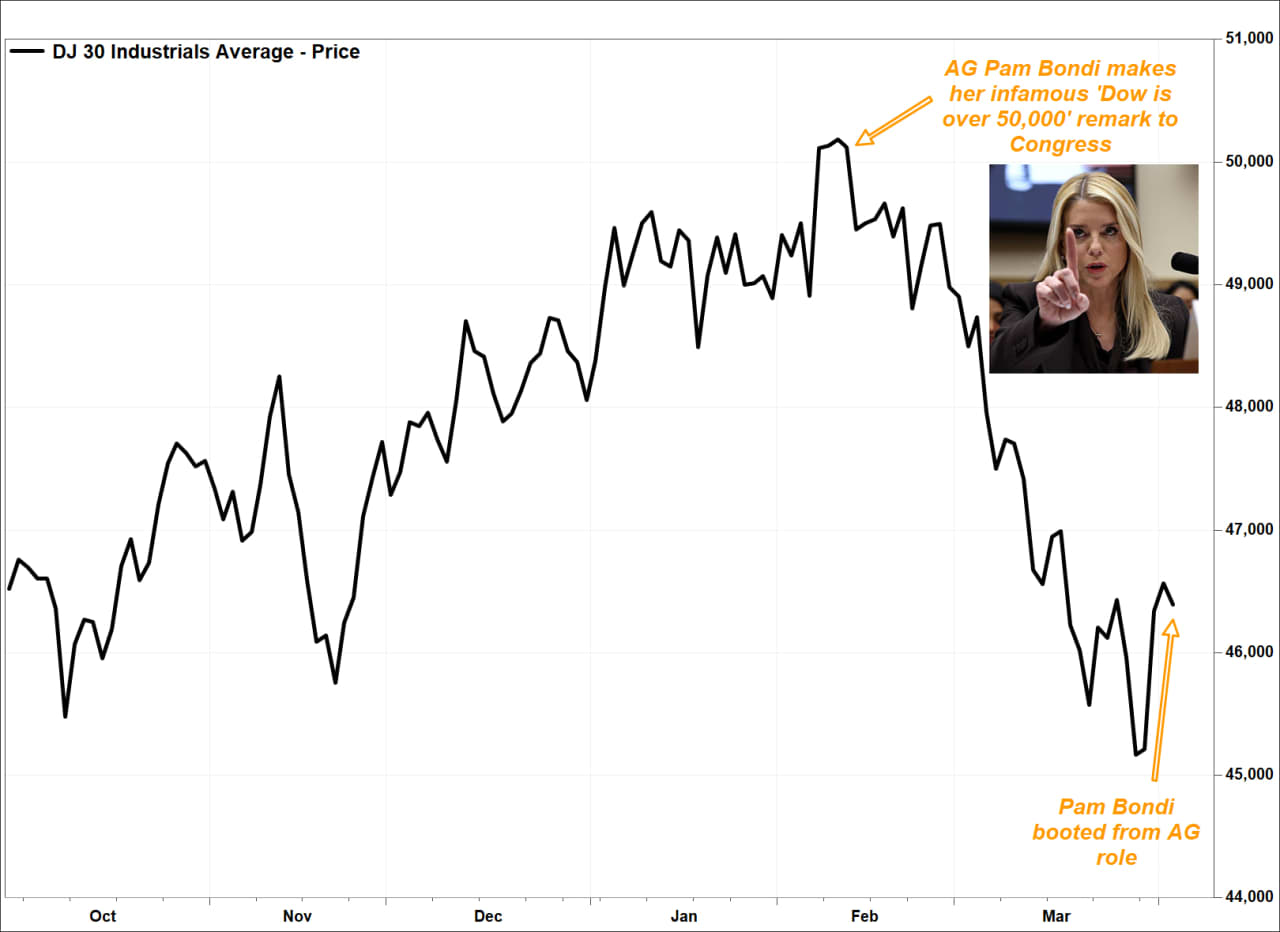
Three things to watch next week: First, TSMC's April 10 earnings could reset the semiconductor narrative and either validate or undercut the AI capex thesis. Second, oil prices remain the macro wildcard — any escalation or de-escalation in Iran will move everything. Third, the Pam Bondi firing adds another layer of political uncertainty; the Dow has not fared well since her now-infamous "Dow is over 50,000" comment.
The AI sell-off may have gone too far. Companies in the sector continue reporting strong growth quarter after quarter, yet stocks have broadly declined. For investors with a multi-year horizon, the disconnect between fundamentals and price action in names like Nvidia, Palantir, and ServiceNow could represent opportunity — provided the macro backdrop doesn't deteriorate further.